Most companies say they want to increase EBITDA. Few actually take a structured approach to doing it. The default move is to chase revenue, cut a few costs, and hope profitability improves. In reality, EBITDA growth comes from a set of deliberate decisions across pricing, operations, and financial discipline.
The gap usually isn’t an effort. It’s visibility. Leadership teams don’t always have a clear breakdown of where margins are being lost, which customers are truly profitable, or how operational inefficiencies are impacting the bottom line. Without that clarity, decisions are made in isolation rather than as part of a strategy.
EBITDA is one of the most important metrics for valuation, lending, and long-term growth. Improving it doesn’t require a complete overhaul of the business. It requires identifying the highest-impact levers and executing on them in the right order.
Understanding EBITDA and What Actually Drives It
What EBITDA Really Measures
EBITDA is a straightforward concept, but it’s often misunderstood or oversimplified.
- Earnings before interest, taxes, depreciation, and amortization
- Strips out financing decisions and accounting treatments
- Focuses on core operating performance
- Used by:
- Investors
- To evaluate profitability and scalability
- Lenders
- To assess the ability to service debt
- Buyers in M&A
- As a primary driver of valuation multiples
- Investors
What matters here is that EBITDA reflects how well the business performs operationally, not how it’s financed or structured.
Core EBITDA Drivers
There are only a few levers that actually move EBITDA, and everything ties back to these.
- Revenue growth
- Increasing top-line sales
- Needs to be profitable growth, not just volume
- Gross margin improvement
- Increasing the spread between revenue and cost of goods or services
- Driven by pricing, cost control, and efficiency
- Operating expense control
- Managing overhead without limiting growth
- Ensuring expenses scale appropriately with revenue
These drivers are interconnected. Improving one while ignoring the others limits the overall impact.
Why EBITDA Improvement Is Not Just Cost Cutting
A common mistake is treating EBITDA improvement as a cost-cutting exercise.
- Cutting expenses alone can stall growth
- Reducing headcount or resources can impact revenue generation
- Short-term gains often lead to long-term constraints
- Balance between:
- Revenue expansion
- Growing the business in a way that adds margin
- Efficiency gains
- Delivering products or services more effectively
- Revenue expansion
The goal is not to shrink the business to improve margins. It’s to build a more efficient, more profitable operation that can scale.
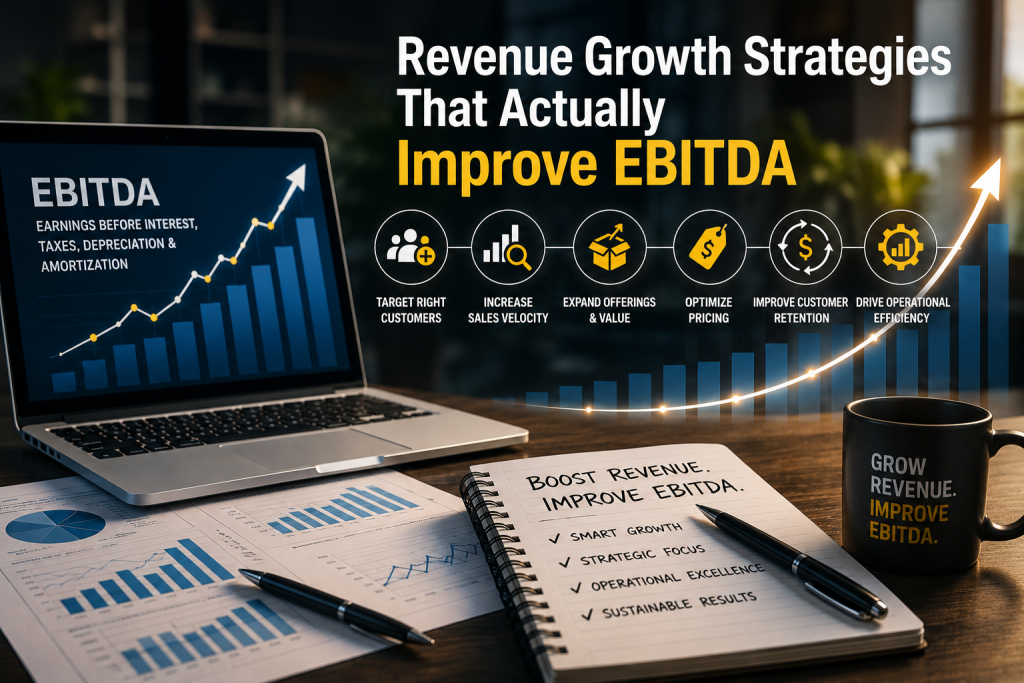
Revenue Growth Strategies That Actually Improve EBITDA
Focus on High-Margin Revenue
Not all revenue contributes equally to EBITDA. The fastest way to improve profitability is to shift focus toward what already generates the strongest margins.
- Identify the most profitable products and services
- Break down revenue by margin, not just volume
- Highlight offerings with the highest contribution to EBITDA
- Shift sales focus toward:
- Higher-margin offerings
- Prioritize these in sales conversations and marketing
- Repeatable service lines
- Scalable services with consistent delivery and lower variability
- Higher-margin offerings
This approach increases EBITDA without requiring a proportional increase in cost or complexity.
Pricing Optimization
Pricing is one of the most underutilized levers for improving EBITDA. Small adjustments can have an immediate impact.
- Evaluate current pricing structure
- Many companies underprice due to competition or outdated models
- Pricing often doesn’t reflect the actual value delivered
- Strategies:
- Value-based pricing instead of cost-plus
- Price based on outcomes and impact, not internal cost
- Incremental price increases without losing customers
- Test small increases across segments
- Monitor retention and adjust accordingly
- Value-based pricing instead of cost-plus
Even modest pricing improvements can significantly increase margins without adding overhead.
Customer Mix Improvement
Who you sell to matters as much as what you sell.
- Identify low-margin or high-maintenance clients
- Clients that require excessive support or customization
- Contracts that compress margins due to pricing or scope
- Prioritize:
- Clients with higher lifetime value
- Repeat business, longer contracts, stronger relationships
- Contracts with better terms
- Clear scope, favorable pricing, predictable delivery
- Clients with higher lifetime value
Improving customer mix reduces operational strain while increasing overall profitability.
Improving Gross Margins
Cost of Goods Sold (COGS) Optimization
COGS is one of the most direct levers for improving EBITDA. Small percentage improvements here can create meaningful margin gains.
- Renegotiate vendor contracts
- Revisit pricing with existing suppliers based on volume or long-term relationships
- Identify opportunities for discounts, rebates, or improved terms
- Consolidate suppliers
- Reduce the number of vendors to increase purchasing power
- Simplify procurement and reduce variability in costs
- Evaluate alternative sourcing
- Identify lower-cost suppliers without sacrificing quality
- Consider geographic or logistical adjustments to reduce costs
Operational Efficiency in Delivery
How products or services are delivered directly impacts margin.
- Reduce labor inefficiencies
- Identify time-consuming tasks that don’t add value
- Improve scheduling, staffing, and resource allocation
- Standardize processes
- Create repeatable workflows for consistent delivery
- Reduce variation that leads to higher costs
- Eliminate rework and errors
- Address quality issues that require additional time or materials
- Improve training and process controls to prevent recurring problems
Product or Service Line Rationalization
Not every offering contributes positively to EBITDA. Some reduce overall profitability.
- Identify underperforming offerings
- Analyze margins by product or service line
- Look for low-margin or inconsistent performers
- Eliminate or restructure:
- Low-margin products
- Phase out or adjust pricing and cost structure
- Services that consume disproportionate resources
- Redesign delivery or limit scope to improve efficiency
- Low-margin products
Cleaning up the offering mix allows the business to focus on what actually drives profit, not just revenue.
Reducing Operating Expenses Without Hurting Growth
Identify Non-Essential Overhead
Most businesses carry expenses that no longer serve a clear purpose. Cleaning these up improves EBITDA without affecting operations.
- Audit expenses:
- Subscriptions
- SaaS tools that are underused or duplicated
- Administrative costs
- Office expenses, support services, and non-critical spend
- Redundant roles
- Overlapping responsibilities across teams
- Subscriptions
The goal is to remove waste, not cut capabilities.
Right-Sizing the Organization
Staffing should match current revenue, not projected growth that hasn’t materialized yet.
- Align staffing with revenue levels
- Evaluate productivity per employee
- Ensure roles are tied to actual output and demand
- Avoid over-hiring in anticipation of growth
- Hiring ahead of revenue creates margin pressure
- Scale the team as revenue becomes predictable
This keeps overhead in line while maintaining operational performance.
Outsourcing vs In-House
Not every function needs to be internal. Some are more efficient and cost-effective when outsourced.
- Evaluate functions like:
- Accounting
- HR
- Marketing
- Outsource where more cost-effective
- Access specialized expertise without full-time cost
- Reduce payroll burden and benefit expenses
This approach allows the business to stay focused on core revenue-generating activities.
Technology and Automation
Manual processes increase cost and reduce accuracy. Automation improves both efficiency and visibility.
- Implement tools to:
- Reduce manual work
- Automate repetitive tasks across operations and finance
- Improve reporting accuracy
- Real-time dashboards and financial tracking
- Reduce manual work
Improving Sales Efficiency
Increase Revenue Per Sales Rep
Improving EBITDA doesn’t always require more salespeople. It often comes down to getting more output from the existing team.
- Train the sales team on:
- Higher-value offerings
- Focus conversations on services or products with stronger margins
- Position premium options as the default, not the upgrade
- Closing larger deals
- Shift away from transactional sales toward bundled or expanded scopes
- Encourage upsells and longer-term contracts
- Higher-value offerings
This increases revenue without adding headcount, which directly improves EBITDA.
Shorten Sales Cycles
Long sales cycles tie up resources and delay revenue recognition. Reducing friction in the process improves efficiency.
- Identify bottlenecks in the pipeline
- Delays in follow-up
- Slow proposal turnaround
- Unclear decision-making from prospects
- Improve:
- Lead qualification
- Focus on prospects that match ideal customer criteria
- Reduce time spent on low-probability deals
- Proposal process
- Standardize templates and pricing structures
- Reduce back-and-forth and approval delays
- Lead qualification
Faster cycles mean more deals closed in the same timeframe with the same resources.
Improve Conversion Rates
Better conversion rates increase revenue without increasing lead volume or marketing spend.
- Refine messaging and positioning
- Clearly communicate value and outcomes
- Address objections earlier in the process
- Focus on:
- Ideal customer profiles
- Target prospects that align with high-margin, repeatable business
- Better targeting
- Align marketing and sales efforts to attract the right leads
- Ideal customer profiles
Improving conversion rates increases efficiency across the entire sales process and directly impacts EBITDA.
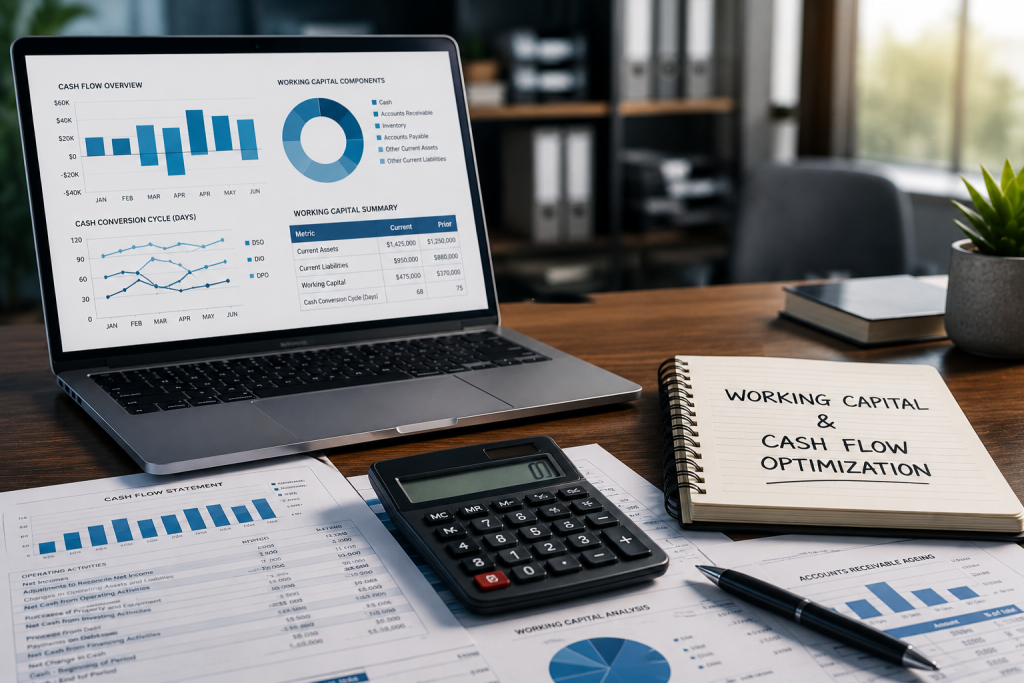
Working Capital and Cash Flow Optimization
Improve Accounts Receivable
Delayed payments directly impact cash flow and create unnecessary strain on the business.
- Tighten payment terms
- Move from net-30 or net-60 to shorter cycles where possible
- Require deposits or milestone payments for larger projects
- Enforce collections process
- Set clear follow-up timelines for overdue invoices
- Assign ownership of collections instead of treating them as a passive function
Faster collections improve cash availability without increasing revenue.
Manage Inventory More Efficiently
Excess inventory ties up cash and reduces flexibility.
- Reduce excess inventory
- Identify slow-moving or obsolete items
- Align purchasing with actual demand patterns
- Improve turnover rates
- Increase frequency of inventory movement
- Reduce holding periods to free up working capital
This is especially important for product-based businesses where inventory can become a hidden drain on resources.
Extend Payables Strategically
Managing outgoing cash is just as important as managing incoming cash.
- Negotiate longer payment terms with vendors
- Extend payables without damaging relationships
- Align payment timing with revenue cycles
This creates a more balanced cash flow structure and reduces short-term pressure.
Why This Impacts EBITDA
Working capital improvements don’t directly change EBITDA, but they strengthen the business in ways that support it.
- Better cash flow reduces reliance on financing
- Less need for short-term borrowing or credit lines
- Lower financial pressure on operations
- Improves operational flexibility
- More cash available to invest in growth initiatives
- Ability to act quickly on opportunities without constraint
The result is a more stable, efficient operation that supports sustained EBITDA growth.
Strategic Cost Allocation and Financial Visibility
Improve Financial Reporting
Most companies don’t have a clear enough view of where profit is actually coming from. Without that, EBITDA improvement becomes guesswork.
- Monthly reporting with clear breakdowns:
- Revenue by segment
- Understand which business lines are driving top-line growth
- Margin by product or service
- Identify which offerings are truly profitable
- Expense categories
- Track where money is being spent and how it scales with revenue
- Revenue by segment
The goal is to move beyond basic financial statements into actionable reporting.
Identify Profit Leaks
Profit leaks are areas where money is being lost but are not clearly visible in standard reporting.
- Hidden costs in:
- Projects
- Scope creep, inefficient delivery, or underestimated labor
- Departments
- Overstaffing, duplicated roles, or low productivity
- Client relationships
- High-maintenance clients that consume more resources than they generate
- Projects
Identifying these leaks allows for targeted fixes instead of broad cost-cutting.
Use Data for Decision Making
Improving EBITDA requires a shift in decision-making.
- Shift from reactive to proactive management
- Anticipate issues based on trends instead of reacting after the fact
- Use data to guide planning and forecasting
- Make decisions based on:
- Real margins
- Understand actual profitability at a granular level
- True cost structures
- Factor in all direct and indirect costs when evaluating performance
- Real margins
This level of visibility allows leadership to prioritize actions with the greatest impact on EBITDA.
Real-World Scenario
Operational Inefficiency to EBITDA Growth
This example shows how multiple small improvements across operations, finance, and strategy can compound to yield a significant increase in EBITDA.
The Challenge
- Business generating $14.7M in revenue
- Struggling with low gross margins driven by operational inefficiencies
- Cash flow issues caused by:
- High Accounts Receivable (slow collections)
- Excess inventory levels are tying up capital
- EBITDA baseline:
- $486K, limiting growth flexibility and overall valuation
Strategic Approach
A focused, multi-step plan was implemented to address both operational inefficiencies and financial bottlenecks.
- Investment in automation
- $1.4M allocated to streamline operations
- Reduced manual processes and improved efficiency
- Increased investment in product development
- $800K increase in annual R&D spend
- Strengthened product offering and long-term competitiveness
- Accounts Receivable improvements
- Implemented structured collections process
- Reduced outstanding receivables and improved cash flow timing
- Inventory optimization
- Introduced demand forecasting
- Lowered excess inventory and improved turnover
The Results
- $2M reduction in COGS
- Direct improvement to gross margins
- Resulted in approximately $900K increase in EBITDA
- $600K reduction in Accounts Receivable
- Faster cash collection
- Improved working capital position
- $100K reduction in inventory
- Freed up cash tied to excess stock
- Reduced carrying costs
- Increased operating cash flow
- Used to pay down both short-term and long-term debt
- Strengthened overall financial position
EBITDA Impact
- EBITDA grew from $486K to $1.39M
- Nearly tripled over the improvement period
- Growth driven by:
- Margin improvement, not just revenue expansion
- Operational efficiency and financial discipline
Key Takeaways from This Scenario
- EBITDA growth came from multiple coordinated actions, not a single change
- Operational efficiency and financial controls had the largest impact
- Improving cash flow supported long-term stability, not just short-term gains
This is the difference between incremental improvement and structured EBITDA growth.
Why Businesses Work with Kratzer Consulting

Strategic Financial Expertise
Improving EBITDA requires more than surface-level adjustments. It requires a clear understanding of what actually drives profitability.
- Deep understanding of EBITDA drivers
- Identifying where margins are gained or lost
- Connecting operational decisions to financial outcomes
- Experience across industries
- Applying proven strategies in different business models
- Recognizing patterns that impact performance
Customized Approach
No two businesses have the same cost structure, revenue mix, or growth challenges.
- No one-size-fits-all solutions
- Avoiding generic recommendations that don’t apply
- Focusing on what will actually move the needle
- Tailored strategies based on the business model
- Aligning improvements with how the company operates
- Prioritizing initiatives based on impact and feasibility
Focus on Measurable Results
The goal is not just strategy. It’s execution with clear outcomes.
- Clear KPIs
- Defined metrics tied directly to EBITDA improvement
- Ongoing tracking of performance
- Trackable improvements in profitability
- Visibility into what’s working and what’s not
- Adjustments based on real data, not assumptions
Working with the right financial partner turns EBITDA improvement from a goal into a structured, repeatable process.
A Balanced Approach for Increasing EBITDA
Increasing EBITDA comes down to execution across a few key areas, not a single change.
- Revenue growth
- Focused on higher-margin, scalable opportunities
- Margin improvement
- Driven by pricing, efficiency, and cost control at the delivery level
- Cost control
- Managing overhead without limiting growth
Most businesses already have opportunities in each of these areas. The gap is identifying them clearly and acting on them in the right order.
If you want to increase EBITDA, start with a clear financial strategy. Contact Kratzer Consulting for an assessment of your current performance. Identify where you can improve margins, reduce costs, and grow in ways that actually increase profitability.
FAQs
What is the fastest way to increase EBITDA?
Pricing adjustments and cost control typically deliver the quickest impact, especially when applied to high-margin products or services.
How can I increase EBITDA without cutting costs?
Focus on higher-margin revenue, pricing optimization, and improving sales efficiency. Increasing profitability per sale can drive EBITDA without reducing expenses.
Does revenue growth always increase EBITDA?
No. If margins are low or operating costs increase alongside revenue, EBITDA may stay flat or decline.
How often should EBITDA be reviewed?
Monthly, with detailed analysis by segment, product, or service line to identify trends and make timely adjustments.
When should I bring in a financial consultant?
When growth slows, margins start to decline, or there’s limited visibility into where profitability is being gained or lost.